
Founder education
Startup Akademija
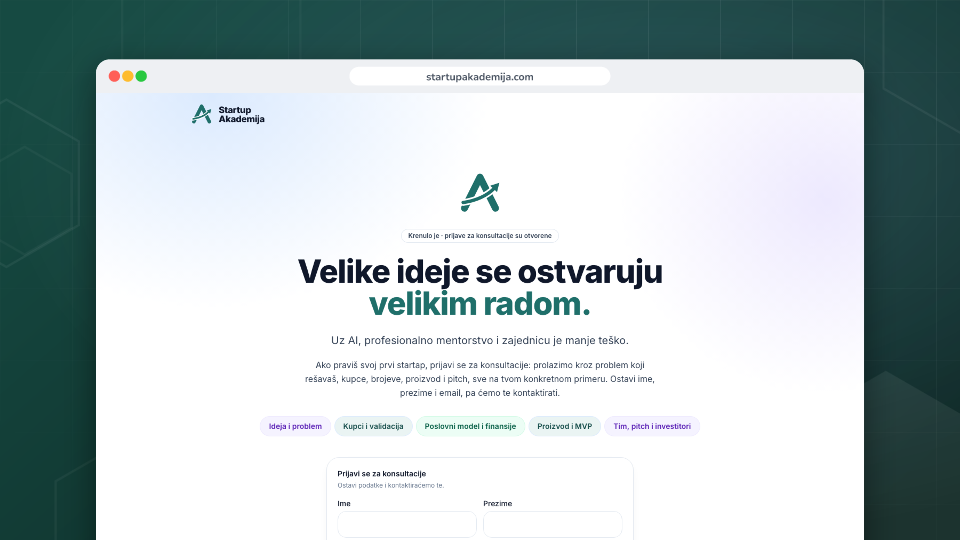
A Serbian-language program for first-time founders: the idea, customers, business model, product and pitch, worked through on the founder's own startup.
Visit the live productWhy founders learn better on their own idea
Most startup education is about other people's companies. A first-time founder watches a course on customer validation, agrees with every slide, and never talks to a single customer, because nothing in the lesson ever touched their own idea.
Startup Akademija works the other way around. Five areas, the idea and the problem, customers and validation, the business model and finances, the product and the MVP, and the team, pitch and investors, are worked through on the startup the person is actually building.
There are two ways in. A platform of fifteen missions is open with a free account, so someone can start alone today. And founders can apply for a consultation that goes through their problem, their customers, their numbers, their product and their pitch, on their own concrete example.
The tone is deliberate. The site promises no shortcut to funding, says plainly that big ideas take big work and that AI, mentoring and a community make it less hard, and runs without tracking cookies or advertising pixels. For people about to bet their savings on an idea, that restraint is part of the product.
What it covers
Idea and problem
Whether the problem is real, for whom, and how badly they want it solved.
Customers and validation
Talking to the people who would pay, before building anything for them.
Business model and finances
How the money works, and the numbers that decide whether it can.
Product and MVP
The smallest version that tests the riskiest assumption.
Team, pitch and investors
Who builds it, how to explain it, and when outside money makes sense.
Built with
For your product
What this says about how we work
This is the same order we use when a founder comes to us with an idea rather than an app: the problem and the customer before the architecture, and the smallest build that tests the riskiest assumption. Teaching it to first-time founders keeps us honest about how much of building a company happens before any code is written.
Questions people ask
- Who is it for?
- People building their first startup: individuals with an idea, students, and employees moving into founding. The program is in Serbian.
- What does it cost to start?
- The platform of fifteen missions is open with a free account.
- What happens in a consultation?
- A conversation about your own case: the problem you solve, your customers, your numbers, your product and your pitch.
- What happens to my data?
- The site keeps your name and email only to get back to you, uses no tracking cookies or advertising pixels, and deletes the data on request.
What we did on this one
- Product design
- Backend development
- Frontend development
Your project
Build something like this
Get a preliminary budget, timeline and team shape for your product, or talk it through with the engineer who would deliver it.
Other projects
Monitoring SaaS
Server Inspector
Uptime, SSL, domain and API monitoring that tells you something broke before your customers do.
AI matching platform
Work Transcendence
A knowledge graph of what a person knows, where every claim keeps the sentence that proves it, matched to real work requirement by requirement.
Email infrastructure
PigeonAtlas
Email sending for applications: an HTTP API and an SMTP endpoint, Resend-compatible, with your own DKIM key and newsletters that can never delay a password reset.
Keep going
Where to go next
- Read the case studiesChallenge, solution and measured outcome from delivered engagements.Continue
- Calculate project costA guided technical discovery that returns a budget range, timeline and team shape.Continue
- Book a strategy callForty-five minutes with the engineers who would actually build it.Continue