
Monitoring SaaS
Server Inspector
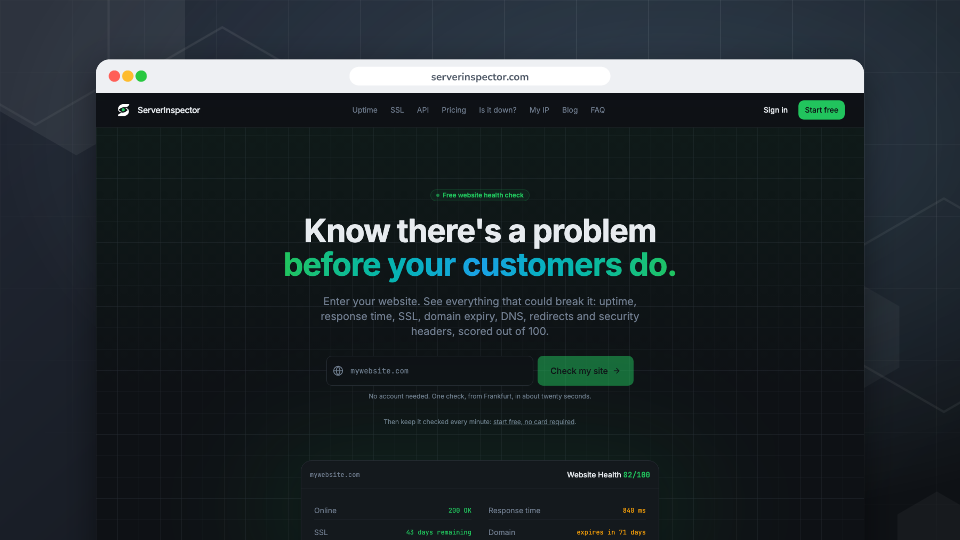
Uptime, SSL, domain and API monitoring that tells you something broke before your customers do.
Visit the live productWhy we built an uptime monitor when there are fifty of them
Every team we work with has the same quiet gap. The app is live, customers are paying, and nobody finds out it is broken until a customer says so. Monitoring is on the list. It stays on the list, because evaluating five tools and configuring one takes an afternoon that never arrives.
The tools themselves are part of the problem. The free ones ping the homepage every five minutes, which catches a server that is down and misses the failure that actually costs money: a page returning a clean 200 while checkout quietly stopped working. The serious ones are configured for an organization that has an operations function, and priced for one too.
So we built the thing we kept wishing existed. Server Inspector checks a website, a server or an API endpoint every minute, scores what it finds out of 100, and tells one person by email when something is wrong. Setup is a URL and an address. That is the whole configuration.
The part we spent the most time on is the part nobody advertises. An alerting system is judged entirely by its false positives, because the first noisy week is the week it gets muted, and a muted monitor is worse than none. Alerts are confirmed before they fire, grouped by application instead of arriving one per check, and a recovery is never reported unless the service actually recovered.
What it checks
Uptime and response time
One minute checks on paid plans, with status code validation rather than a bare connection test. Response time is tracked over time, because the slow week before an outage is the one worth seeing.
Keyword monitoring
The check that catches silent failures. If a page is supposed to say Payment successful and stops saying it, that is an alert, even though the server is cheerfully returning 200 to everyone who asks.
SSL, domain and DNS
Certificate expiry, domain expiry, DNS resolution, redirect chains and security headers. Most of the outages that embarrass a small company are an expiry nobody had a calendar entry for.
Servers and APIs
TCP and port checks, plus REST endpoints with JSON response validation and latency tracking, so a background service that quietly stopped answering is caught the same way a website is.
Status pages and alerts
Email, Slack, Discord, Telegram or a signed webhook, and a branded public status page so customers check a page instead of opening a ticket.
Built with
For your product
What this says about how we work
Server Inspector is a small product with one hard problem inside it, and we went after the hard problem instead of the feature list. That is the same instinct we bring to client work. The interesting question in your system is rarely the one on the roadmap, and finding it early is most of what senior engineering is actually for.
Questions people ask
- Is there a free plan?
- Yes, and it permits commercial use. Ten monitors, five minute checks, thirty days of history and alerts to email, Slack, Discord, Telegram or a webhook, with no card required. Paid plans start at ten dollars a month for one minute checks and longer history.
- How long does setup take?
- About a minute. Paste a URL, hostname or API endpoint, give an email address, and the first check runs immediately. There is no agent to install and no configuration file.
- What makes it different from a free uptime checker?
- Two things. It checks what is on the page, not just whether the page loads, so it catches a checkout that broke while the server stayed healthy. And it is built so that alerts are trustworthy, which is the only property that decides whether a monitor is still switched on six months later.
- Did Golux build this for a client?
- No. It is our own product, which is why we can talk about the decisions inside it in public. Client work stays confidential unless a client asks us to say otherwise.
What we did on this one
- Backend development
- Frontend development
- Business consulting
More from Server Inspector
- serverinspector.comThe 15 things that break an app after you ship itA launch checklist for apps with nobody on call: certificates, the domain, DNS, cold starts and the backend behind the page.Read it
- serverinspector.comKeyword monitoring: catch hidden website outagesWhy a 200 OK is not proof that a page works, and how a content check catches the failures an uptime ping misses.Read it
- serverinspector.comReducing alert fatigue: thresholds, retries and dedupConfirmation checks, flap detection and deduplication, so every alert that fires is one worth reading.Read it
Your project
Build something like this
Get a preliminary budget, timeline and team shape for your product, or talk it through with the engineer who would deliver it.
Other projects
AI matching platform
Work Transcendence
A knowledge graph of what a person knows, where every claim keeps the sentence that proves it, matched to real work requirement by requirement.
Email infrastructure
PigeonAtlas
Email sending for applications: an HTTP API and an SMTP endpoint, Resend-compatible, with your own DKIM key and newsletters that can never delay a password reset.
AI marketing workspace
Merlin Studio
An AI marketing workspace where strategy, brand knowledge and content live in one place, and a person approves the final version.
Keep going
Where to go next
- Read the case studiesChallenge, solution and measured outcome from delivered engagements.Continue
- Calculate project costA guided technical discovery that returns a budget range, timeline and team shape.Continue
- Book a strategy callForty-five minutes with the engineers who would actually build it.Continue