
Email infrastructure
PigeonAtlas
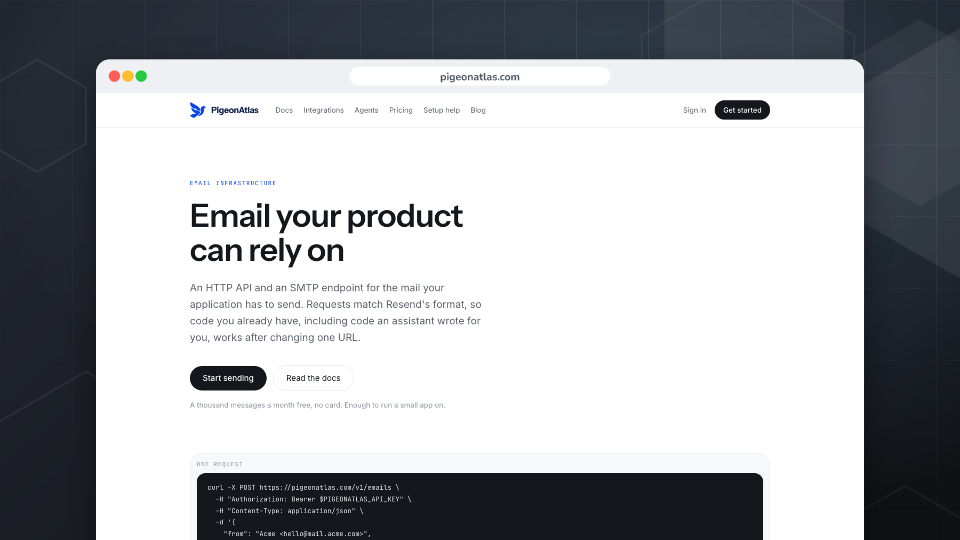
Email sending for applications: an HTTP API and an SMTP endpoint, Resend-compatible, with your own DKIM key and newsletters that can never delay a password reset.
Visit the live productThe password reset that never arrived
Ask anyone who runs an application what email costs them, and the answer is rarely the invoice. It is the support ticket from a user whose password reset landed in spam, or arrived twenty minutes late because a newsletter was going out at the same moment.
PigeonAtlas is built around the few decisions that actually decide whether mail arrives. Transactional and bulk mail are dispatched by separate processes that never read each other's work, so a broadcast to fifty thousand people cannot put a single reset behind it.
Each customer signs with a DKIM key generated for their own domain, and their DNS points only at PigeonAtlas. What runs underneath can change without anyone being asked to edit a record, and the 'via' label Gmail shows when the sending and signing domains disagree goes away.
Moving in is meant to be boring. Requests match Resend's format, so existing code, including code an AI assistant wrote, works after changing one URL. The migration guide covers the step people skip, bringing the suppression list across, which is also the step that costs them.
What it does
One request
An HTTP API and an SMTP endpoint. The response returns as soon as the message is queued, so a slow recipient never slows the application down.
Your own DKIM key
Mail is signed for your domain, with DNS that points only at PigeonAtlas and never needs to change again.
Separate lanes
Transactional and bulk mail never share a queue, so a newsletter can never hold up a reset or a receipt.
Dead addresses stop at the door
A hard bounce or a complaint suppresses an address permanently, checked at submission so it never enters the queue.
See what was sent
Every message is archived as the bytes that actually went out, searchable by recipient, with its full delivery history beside it.
Built with
For your product
What this says about how we work
Email is one of the places where an app built quickly fails quietly: a reset in spam, a receipt that never came, and nobody able to see why. We trace that path in every production review, because it decides whether users can get back into the product, and fixing it is usually a day of work rather than a project.
Questions people ask
- Is it compatible with Resend?
- Yes. Requests match Resend's format, so moving is a base URL and a key.
- Does it work with Lovable and Supabase?
- There is a setup guide for exactly that, alongside SMTP settings, webhooks and an OpenAPI description.
- Is there a free tier?
- A thousand messages a month, with no card, which is enough to run a small app and to prove it works before anything is decided.
- Why separate transactional and bulk mail?
- Because a password reset that waits behind a newsletter is a lost user. Separate processes mean one can never delay the other.
What we did on this one
- Backend development
- Frontend development
- Business consulting
More from PigeonAtlas
- pigeonatlas.comPassword reset emails going to spam: the five checks that usually fix itIn the order they most often turn out to be the cause, each one runnable in about a minute.Read it
- pigeonatlas.comSPF, DKIM and DMARC, explained by what actually breaksThree DNS records with three different jobs, and the specific ways each one fails without telling anyone.Read it
- pigeonatlas.comSending email from Lovable or Supabase Edge FunctionsA working Edge Function that sends over HTTP, and why SMTP is the wrong choice in that environment.Read it
Your project
Build something like this
Get a preliminary budget, timeline and team shape for your product, or talk it through with the engineer who would deliver it.
Other projects
Monitoring SaaS
Server Inspector
Uptime, SSL, domain and API monitoring that tells you something broke before your customers do.
AI matching platform
Work Transcendence
A knowledge graph of what a person knows, where every claim keeps the sentence that proves it, matched to real work requirement by requirement.
AI marketing workspace
Merlin Studio
An AI marketing workspace where strategy, brand knowledge and content live in one place, and a person approves the final version.
Keep going
Where to go next
- Read the case studiesChallenge, solution and measured outcome from delivered engagements.Continue
- Calculate project costA guided technical discovery that returns a budget range, timeline and team shape.Continue
- Book a strategy callForty-five minutes with the engineers who would actually build it.Continue