
Golux Group

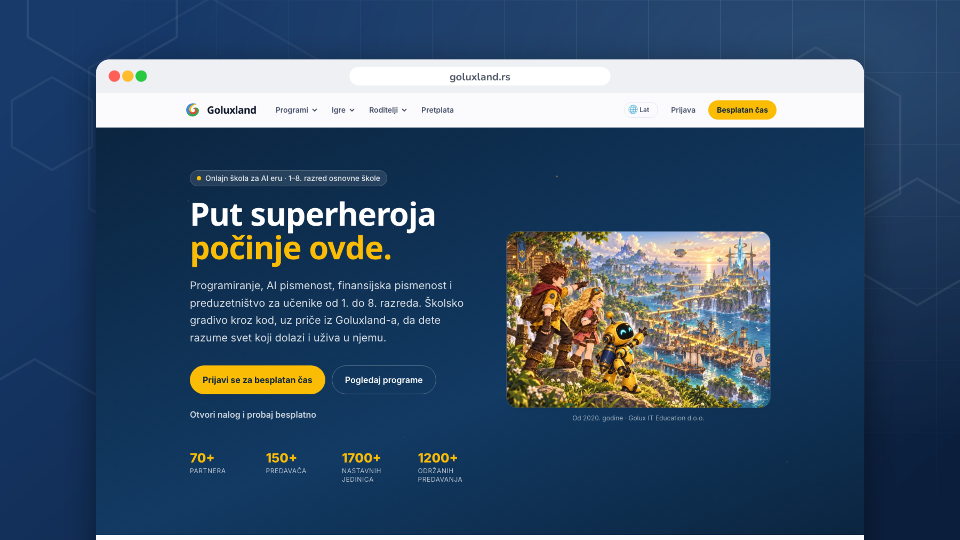
Goluxland: A School, Not Just an App

Goluxland: A School, Not Just an App

An online school for grades 1 to 8 that splits the work honestly: the platform carries daily practice, a teacher carries the group.

Open the live product
  • Application
  • Design
  • Business
Location
Belgrade, Europe
Team
Golux Group
Project type
Platform · EdTech
Year
2026

Business challenge

Learning apps for children are good at streaks and bad at understanding. A child collects points for a month, the novelty fades, and nobody notices that the concepts never landed. Online schools have the opposite problem: a live class once a week with nothing in between. Parents end up choosing between engagement without depth and depth without practice.

What we did

We built Goluxland to do both and to be clear about which part does what. Short missions of ten to fifteen minutes on the platform carry daily practice, and live classes in small groups carry explanation, projects and feedback. The curriculum runs in four one-year programs of two school grades each, moving from Scratch to real Python and a first website, and treats money, risk and entrepreneurship as things to understand rather than advice to follow. Progress is levels and a map of skills, with no penalty for a missed day and no public ranking, because a child who is ranked last stops coming. The site states openly which program has every mission ready and which are being published during the school year.

What shipped

  • Four one-year programs covering grades 1 to 8, each with platform missions and live classes
  • A path from Scratch to real Python and a first website
  • Live classes in small groups, with homework that gets feedback
  • Levels and a skill map with no penalties for missed days and no public ranking
  • Demo missions, including real Python, that run in the browser without an account
  • A public, honest statement of which program content is complete and which is still being released

How we built it

We began with the parent's question, not the child's. A parent wants to know whether their child is actually learning, and most apps answer with points and streaks, which measure attendance rather than understanding. Everything else was designed to give a better answer to that question.

So the work was split honestly. The platform carries daily practice in short missions of ten to fifteen minutes. Live classes in small groups carry explanation, projects and feedback. Asking the app to do the teacher's job, or the teacher to do the app's, is where most education products go wrong.

The curriculum was laid out before the platform: four one-year programs of two school grades each, a path from Scratch to Python to the web, and money, risk and entrepreneurship taught as things to understand. School math and physics are solved in code, so the platform reinforces school rather than competing with it.

Then the mechanics, chosen for children rather than for engagement charts. Levels and a map of skills, but no penalty for a missed day and no public ranking. A child who is ranked last stops coming, and that child is usually the one who needed it most.

The last decision was about honesty in public. The site says which program has every mission ready and which are being released during the school year. AI helped us draft and check throughout. What we would and would not promise to parents was decided by people.

The method, in order

  1. Answer the buyer's real question

    Parents want evidence of learning, so progress is shown as skills mastered rather than time spent.

  2. Split the work by what each part does best

    Daily practice on the platform, explanation and feedback with a teacher.

  3. Lay out the curriculum before the software

    Programs, grades and the path from Scratch to Python decided first, so the platform serves the teaching.

  4. Remove the mechanics that punish

    No penalties for missed days and no public ranking.

  5. Say what is not finished yet

    Publish the state of the content, so trust is earned rather than assumed.

Built with

  • Ruby on Rails
  • Next.js
  • TypeScript
  • PostgreSQL

For your product

What we would do on your product

Products for non-technical users, children, parents, patients, small business owners, succeed or fail on decisions that are not engineering: what to measure, what to hide, what to promise. We make those decisions explicit at the start, write them down, and build the product to keep them, so the interface never promises more than the system can deliver.

Questions people ask

Why not gamify everything?
Because streaks and rankings measure attendance and punish the children who struggle. Levels and a skill map reward what was mastered without putting anyone last on a list.
Why combine an app with live classes?
Practice and explanation are different jobs. The app is good at daily repetition, and a teacher is good at understanding and feedback. Each does the part it is good at.
Can you build a learning or training platform for us?
Yes, including the curriculum structure, the progress model, the live-class workflow and reporting for parents or managers.

What the work covered

  • Product design
  • Backend development
  • Frontend development
See everything we do

Your project

Want an outcome like this one?

Start with a realistic budget and timeline for your own product, or bring the problem straight to the engineer who would work on it.

The engineering notes

What we find inside AI-built apps.

The findings from the apps we audit, the fixes that worked, and what each one cost, written by the person who did the work. No roundups, no reposts.

A few emails a month. No spam, unsubscribe any time.

Golux Group

Already a client? Golux Club
is where your project lives: tickets, approvals, files, one record.

Open