
Golux Group

Startup Akademija: Learning to Build on Your Own Startup

Startup Akademija: Learning to Build on Your Own Startup

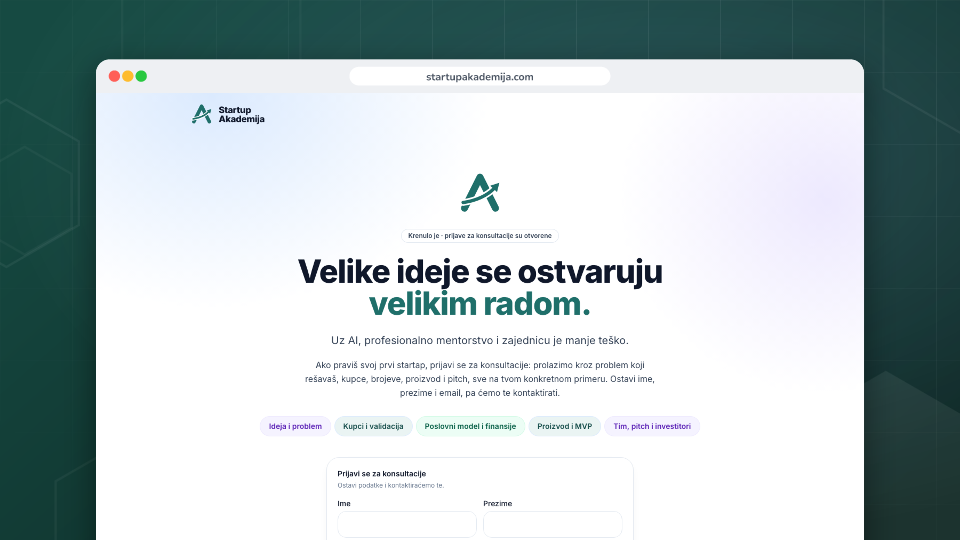
A founder program built on one rule: every lesson is applied to the founder's own idea, not to a case study about somebody else's.

Open the live product
  • Application
  • Business
  • Design
Location
Belgrade, Europe
Team
Golux Group
Project type
Platform · EdTech
Year
2026

Business challenge

First-time founders learn from content written about other people's companies. They take a course on validation, agree with all of it, and never validate anything, because the lesson never touched their own idea. The other common failure is the promise: programs that sell certainty about funding or success they cannot deliver.

What we did

We built the program around the founder's own case. Five areas, the idea and the problem, customers and validation, the business model and finances, the product and the MVP, and the team, pitch and investors, are worked through as missions applied to the startup the person is actually building. Consultations go further, working through the problem, the customers, the numbers, the product and the pitch on that specific example. The public promise is deliberately modest: no false promises, concrete work on your own example, and your data stays with the program. The site runs without tracking cookies or advertising pixels and keeps only what is needed to get back to someone.

What shipped

  • Five learning areas, from the problem to the pitch, applied to the founder's own startup
  • A platform of fifteen missions open with a free account
  • Consultations on the founder's concrete case
  • No tracking cookies or advertising pixels, and data deleted on request

How we built it

The starting point was a pattern we had seen many times: first-time founders who know the theory of validation and have never validated anything. The lessons they took were about other people's companies, so nothing in them ever touched their own idea.

So the first decision was that every lesson is applied to the founder's own startup. Five areas, from the problem to the pitch, are worked through as missions on the idea the person is actually building, not on somebody else's case study.

The second was the order. The problem and the customer come before the business model, and the business model before the product. It is the same order we use with founders who come to us, because building first and asking later is the most expensive way to learn.

The third was restraint in public. The site promises no shortcut to funding, says plainly that big ideas take big work, and runs without tracking cookies or advertising pixels, keeping only what it needs to get back to someone. For people about to risk their savings, that is part of the value.

It started small on purpose: a free platform of fifteen missions and consultations on the founder's own case, to grow once real founders have used it. AI is part of the method, as a tool for drafting and for challenging assumptions. The judgment about what to teach, and in what order, came from people.

The method, in order

  1. Teach on the learner's own case

    Every mission is applied to the startup the founder is building.

  2. Sequence by risk

    Problem and customers first, product last, because the riskiest assumption should be tested first.

  3. Promise less than you deliver

    No claims about funding or success that the program cannot control.

  4. Collect only what you need

    No tracking cookies or advertising pixels, and deletion on request.

  5. Start small and learn

    A free platform and consultations first, expanded once real founders have used them.

Built with

  • Ruby on Rails
  • Next.js
  • TypeScript
  • PostgreSQL

For your product

What we would do on your product

If you have an idea and not yet an app, this is the order we would work in with you: the problem, the customer, the numbers, and only then the smallest product that tests the riskiest assumption. It is usually cheaper and faster than starting with the build, and it is what makes the build worth doing.

Questions people ask

Is this the same advice you give clients?
The same order: the problem and the customers before the business model, and the business model before the product.
Why so little tracking?
Because the audience is about to make a high-stakes decision and deserves a product that collects only what it needs.
Do you work with founders who only have an idea?
Yes. The first step is the same as in the program: the problem, the customer and the numbers, before any architecture.

What the work covered

  • Product design
  • Backend development
  • Frontend development
See everything we do

Your project

Want an outcome like this one?

Start with a realistic budget and timeline for your own product, or bring the problem straight to the engineer who would work on it.

The engineering notes

What we find inside AI-built apps.

The findings from the apps we audit, the fixes that worked, and what each one cost, written by the person who did the work. No roundups, no reposts.

A few emails a month. No spam, unsubscribe any time.

Golux Group

Already a client? Golux Club
is where your project lives: tickets, approvals, files, one record.

Open