
Business challenge
Project tools record intention well and go quiet on the only question a stakeholder asks, which is whether the date holds. Percentage complete is counted in tickets, so a board shows eighty per cent while the remaining twenty per cent contains all of the hard work. Tasks are written at whatever size someone felt like, which means a card can sit in progress for two weeks without anyone being able to say why.
What we did
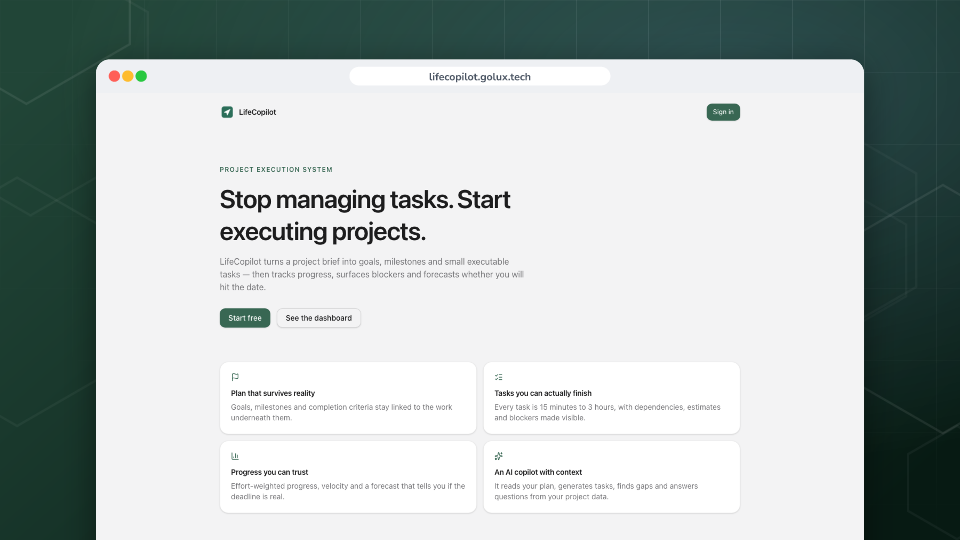
A brief is decomposed into goals, milestones and tasks, with every task sized between fifteen minutes and three hours, which is small enough that a stalled one is visible within a day. Dependencies, estimates and blockers are first-class rather than labels. Progress is effort-weighted instead of counted, and observed velocity drives a forecast against the committed date, so the product states whether the deadline is reachable rather than leaving it to be felt. An AI copilot reads the plan itself, drafts tasks, finds the gaps between a milestone and the work underneath it, and answers questions from the project's own data.
What shipped
- Goals, milestones and completion criteria stay linked to the work beneath them
- Every task sized between fifteen minutes and three hours, with dependencies and blockers made explicit
- Effort-weighted progress and a velocity-based forecast against the committed date
- An AI copilot grounded in the project's own plan and data rather than a general chat window