
Business challenge
Most applications send three kinds of mail through one pipe: password resets, receipts and newsletters. When a broadcast goes out, the reset waits behind tens of thousands of marketing emails and the user who asked for it gives up. Switching providers means asking customers to edit DNS records, so teams stay on a setup they have outgrown. And when mail does not arrive, nobody can see what was actually sent.
What we did
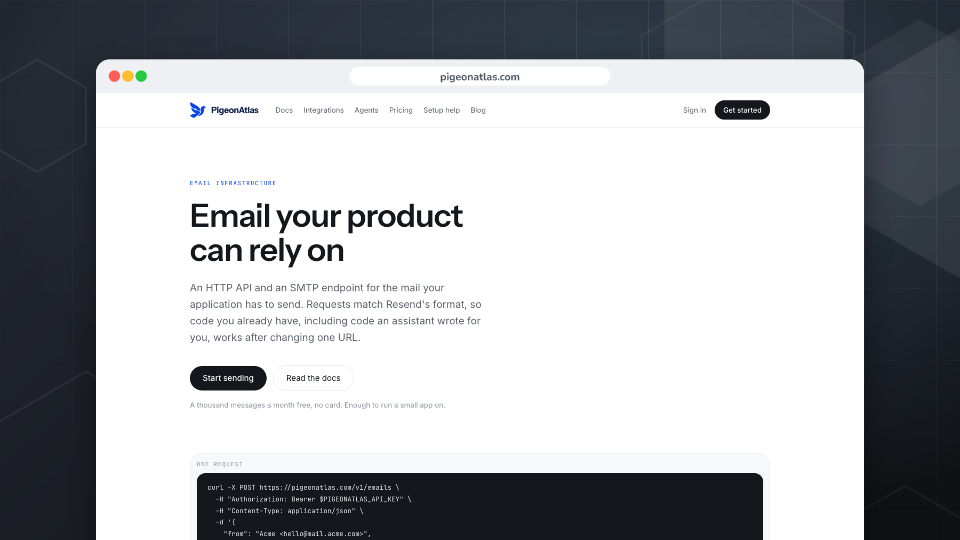
We designed PigeonAtlas around the parts that decide delivery rather than around a feature list. Requests match Resend's format, so moving is a base URL and a key, and code generated by an assistant works unchanged. Each domain gets its own DKIM key while its DNS points only at PigeonAtlas, so what runs underneath can change without anyone touching a record. Bulk and transactional mail are dispatched by separate processes that never read each other's work. A hard bounce or a complaint suppresses an address permanently, checked when the message is submitted so it never enters the queue. Every message is archived as the exact bytes that went out, searchable by recipient, with its delivery history beside it.
What shipped
- An HTTP API and an SMTP endpoint, with Resend-compatible requests
- A DKIM key per customer domain, with DNS that never needs editing again
- Transactional and bulk mail dispatched separately, so a newsletter never delays a reset
- Suppression applied at submission, before a message can enter the queue
- Every sent message archived as delivered bytes, with its full delivery history
- A thousand messages a month free, with setup guides for Resend, Lovable and Supabase, and SMTP