
Golux Group

Merlin Studio: AI Marketing With a Person at the Final Step

Merlin Studio: AI Marketing With a Person at the Final Step

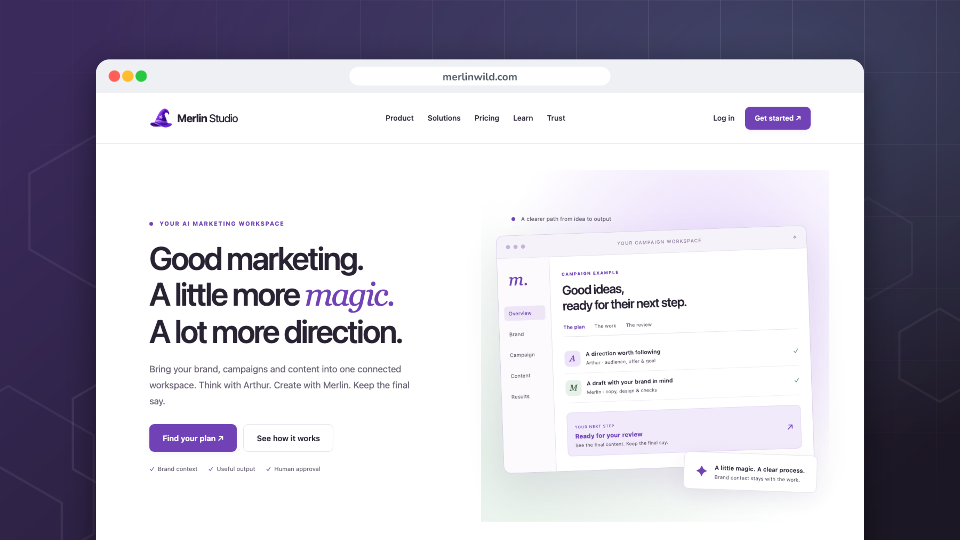
An AI marketing workspace built on one refusal: AI prepares and checks the work, but it never decides on its own what represents the brand.

Open the live product
  • Application
  • Backend
  • Business
Location
Belgrade, Europe
Team
Golux Group
Project type
SaaS · AI product
Year
2026

Business challenge

Teams that adopt generative tools get volume without direction. Content multiplies faster than anyone can review it, it drifts away from how the brand actually speaks, and claims appear that nobody in the company could prove if asked. The quiet problem underneath is accountability: when the tool both writes and publishes, nobody is clearly responsible for what went out under the brand's name.

What we did

We separated thinking from making. Arthur handles strategy, meaning the audience, the offer and the goal, and is built to challenge assumptions before a direction is chosen. Merlin handles execution, turning that direction into briefs, drafts, design and quality checks. Each brand keeps its own knowledge as shared decisions about what it says, how it says it, what it can prove and how its work looks, so consistency comes from the brand rather than from whoever wrote the prompt. Campaign planning starts from a business goal and works backward to a sequence of messages with an offer, a destination and a way to learn. Approval is an explicit step on the real final version, and sources and assumptions stay visible while the message is being shaped.

What shipped

  • Strategy and execution split between two counterparts, Arthur for direction and Merlin for the work
  • Brand knowledge kept per brand, so several brands with different voices can live in one workspace
  • Campaign planning that starts from a business goal rather than from an empty calendar
  • A human approval step on the actual copy and visuals before anything is published
  • No invented success metrics: sources and assumptions stay visible next to the message

How we built it

The starting question was not what AI could generate. It was who is responsible for what gets published. Every team we watched adopt generative tools hit the same wall in the second month: plenty of drafts, no clear owner, and a growing number of claims nobody in the company could prove.

So the first decision was structural, and it was made before any model was involved. AI would prepare and check the work, and a person would approve the real final version. Everything else was then designed around keeping that boundary clean and visible, rather than around how much the system could produce.

Next came the brand itself. Consistency does not come from a better prompt, it comes from decisions a brand has already made. We modeled those decisions as shared knowledge per brand: voice, proof and visual standards. That is what lets several brands with very different voices live in one workspace without bleeding into each other.

Then the split between strategy and execution. Arthur and Merlin are separate on purpose. A single assistant that both chooses the direction and produces the work drifts toward whatever is easiest to produce. Separating them gives a direction the chance to be questioned before anything is made from it.

Campaign planning came last and was built backward: from the business goal, to the change you want a specific audience to make, to the message and the offer, and only then the calendar. AI sat in the work throughout, used the way we use it everywhere, to draft and to argue with a decision before it was made. The boundaries were decided by people.

The method, in order

  1. Decide who is responsible before deciding what to automate

    The approval boundary was written down before any feature. Automation that blurs responsibility saves time once and costs trust every time after that.

  2. Model the brand as decisions, not prompts

    Voice, proof and visual standards kept as shared knowledge per brand, so the output is grounded in what the brand has decided rather than in who wrote the request.

  3. Separate direction from execution

    Strategy and production are different jobs with different failure modes. Keeping them apart lets the direction be challenged before work is made from it.

  4. Plan backward from the goal

    Start from the change a specific audience should make, then choose the message and offer, then the sequence. Filling a calendar first is how campaigns end up busy and pointless.

  5. Make approval a real step on the real version

    A person reviews the actual copy and visuals that will ship, with the sources and assumptions behind them still visible.

Built with

  • Ruby on Rails
  • Next.js
  • React
  • PostgreSQL
  • LLM APIs

For your product

What we would do on your product

If you are adding AI to a product your customers see, we start with the same question: where does the model stop and a person start, and how will anyone be able to tell? We write that boundary down in the first week, design what grounds the output, and only then build the generation. You see each decision in writing before it ships.

Questions people ask

Why design the approval step first?
Because everything downstream depends on it. Once a system publishes on its own, adding a review step later means rebuilding the workflow around it. Deciding it first costs almost nothing.
Why separate strategy from execution?
A single assistant that both chooses the direction and produces the work optimizes for producing. Two counterparts with different jobs give the direction a chance to be questioned before anything is made.
How do you keep AI output consistent with a brand?
Give the system a clear set of brand decisions and examples before asking for anything, then review the output for meaning, evidence and voice, not just formatting.
Can you build an approval workflow into our product?
Yes. Most AI features we are asked to look at are missing exactly this: a clear point where a person decides, and a record of what they approved.

What the work covered

  • Backend development
  • Frontend development
  • Product design
See everything we do

Your project

Want an outcome like this one?

Start with a realistic budget and timeline for your own product, or bring the problem straight to the engineer who would work on it.

The engineering notes

What we find inside AI-built apps.

The findings from the apps we audit, the fixes that worked, and what each one cost, written by the person who did the work. No roundups, no reposts.

A few emails a month. No spam, unsubscribe any time.

Golux Group

Already a client? Golux Club
is where your project lives: tickets, approvals, files, one record.

Open